
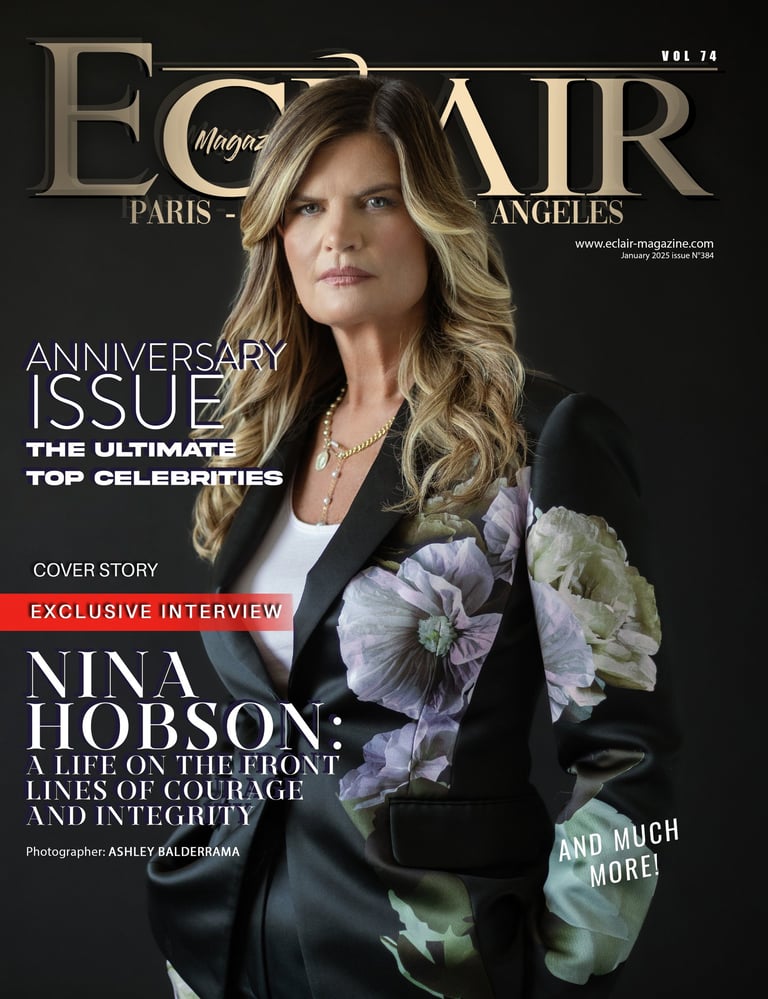
EXCLUSIVE INTERVIEW
Nina Hobson:
A Life on the Front Lines of Courage and Integrity
Conducted by Guillaume Jean Lefebvre
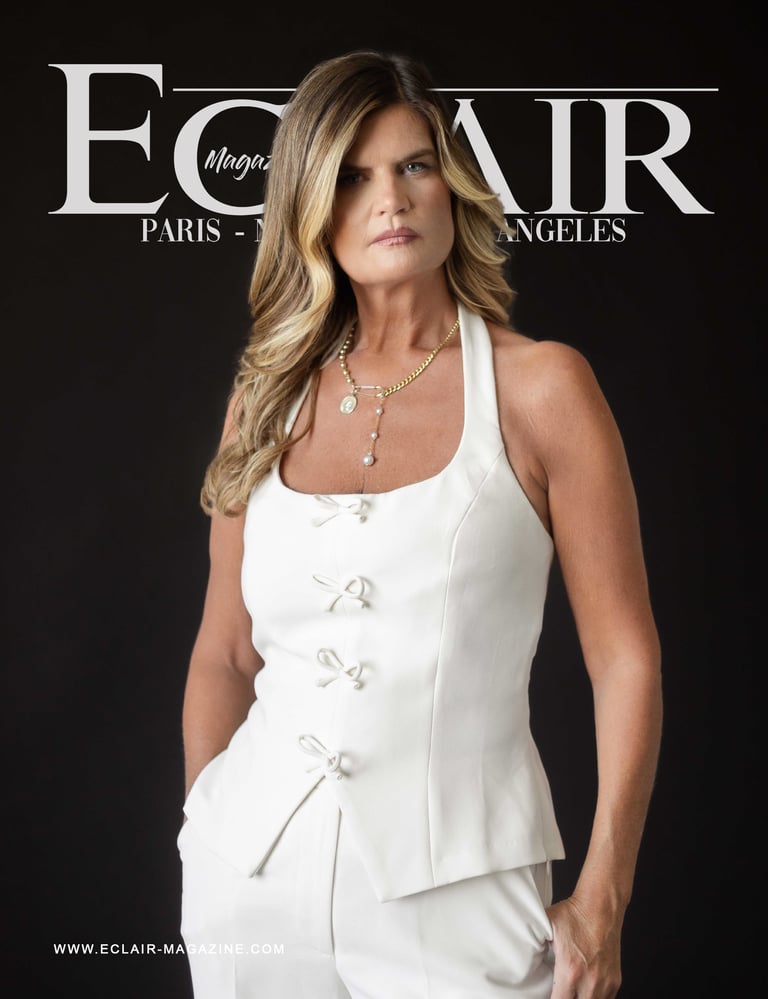
You spent 15 years on the front lines of the British police, investigating cases of murder, rape, kidnapping, and fraud. What lessons have you learned from these challenging experiences?
That not everyone is bad. I once went to a psychologist and asked what was wrong with me. I had seen so many horrific things that I thought I could no longer possibly be normal, right? But I was not only diagnosed as normal but also fortunate that it didn’t affect me, and that I could deal with a pedophile one moment and be nagging my kids to do their homework the next. Despite seeing so many horrific things in my life, and often not understanding people’s motivation, I do know that there are lots of good people in this world. I’ve learned that I can’t save everyone. I used to want to save everyone and I still do, but I know it’s not possible. People will always be bad, and that’s not okay, but if I can make a tiny bit of difference, then I can be happy with that. I have also learned that I am privileged to have had the experiences I’ve had. It sounds weird—how can you be privileged by seeing such horrible sides of life, right? But I am, because many people will never be able to understand that.You are now one of the only women leading executive protection teams with your level of expertise. What motivated you to enter this male-dominated field?
It wasn’t motivated by the fact that it was a male-dominated environment. I think I was motivated by my desire to protect people and help people have a normal life. Whether it’s a celebrity who has attention due to their talent, an heir exposed due to their background, a high-net-worth person exposed due to money, a child exposed to abuse, or a suicidal person fighting for their life—some choosing it, some not—I just want to help everyone be given the opportunity for a little bit of normal. Something I am very privileged to say I have had.Your career has brought you to protect high-profile figures. How do you approach the responsibility of safeguarding such exposed individuals?
As if they are my own family. It doesn’t matter who you protect—we do our job exactly the same, and we take each client’s safety and security very seriously. Yes, the risks may change and the environment may be different, but the responsibilities are the same. My job is to make sure that EVERYONE gets home safe and well to their loved ones. That’s the clients, my team, and me. We are all as important as each other. Would we take a bullet for each other? Absolutely. And that is something I am very proud to say. The responsibility is huge. You are saving someone’s life. I always say that I hope I am my clients’ biggest waste of money—that they never get to see our true value or how good we actually are. One of the hardest parts is that you are never off duty, even when you are. Always aware, always covering someone else’s back. You should see us if we go out for dinner as a team—no one wants to sit with their back to the door!In 2006, you exposed corruption within the British police and took part in a documentary. Can you share the challenges you faced during this operation?
The challenges were incredible. Every aspect of my life was endangered. I was risking losing my freedom, being a mum, having a family, a career—everything was on the line. Mentally, I had to be on my A-game to survive, yet I was putting myself through such mentally challenging situations every day. I had to lie to my loved ones, my nearest and dearest, but still stay true to my own moral compass despite it being tested every day. It wasn’t just the mental challenges; it was also the practical ones. Being at the police station before anyone else to ensure all my equipment was working correctly, flushing the toilet every two hours so as not to be detected, changing the batteries of the recording device, not removing my stab vest for fear someone might pick it up and feel the weight difference, counter-surveillance in my locker in case I was under suspicion, vomiting on the way to work and wiping the tears away every day as I bawled my eyes out on the drive—leaving my kids not knowing if it was going to be the last time I saw them outside of prison walls. “Tough” is an understatement.
Nina Hobson has spent over fifteen years on the front lines of British law enforcement, confronting some of the darkest aspects of human behavior. From investigating violent crime and abuse to tackling fraud and exploitation, she has faced challenges that would have hardened many—but instead, they shaped a woman guided by empathy, resilience, and an unshakable moral compass.
Rather than losing faith in humanity, Nina’s career reinforced a profound belief: while darkness exists, so does extraordinary goodness. She quickly understood that she could not save everyone—but making even a small difference matters. This philosophy continues to guide her both professionally and personally.
After leaving the police, Nina transitioned into one of the most demanding and discreet arenas in the world: executive protection and high-risk security operations. Now recognized as one of the few women leading protection teams at this level, she approaches every mission with the mindset of treating those under her care as family. For Nina, safety is not a service; it is a responsibility. Every team member matters equally, and the ultimate goal is simple: ensuring that everyone returns home safely.
Her career has also been marked by extraordinary acts of courage. In the mid-2000s, she participated in a high-risk op1eration that exposed deep-rooted corruption within the police force—putting her freedom, career, and family life at serious risk. Navigating constant psychological pressure, maintaining secrecy, and facing potential imprisonment required immense strength, leaving one of the most defining chapters in her life. For Nina, it reinforced a simple truth: integrity is never optional—it is essential.
Nina’s commitment to justice extends far beyond her own country. She has worked on the ground in Africa, supporting anti-poaching missions and witnessing both the resilience of life and the brutality of senseless crime. From life-threatening encounters in the wilderness to moments of quiet humanity and shared laughter, these experiences deepened her respect for those who protect others not for recognition, but out of pure conviction.
She is also deeply involved in combating human trafficking and supporting rescue operations. Inspired by her mother’s quiet courage and moral clarity, Nina believes that choosing not to act is the greatest failure of all. Even when outcomes are uncertain, she teaches that trying is a responsibility we all share.
Today, her expertise is sought after as a consultant to ensure realism and authenticity in complex investigative and security-related productions. Having lived these realities firsthand, Nina brings credibility that cannot be fabricated. For her, truth matters—because audiences deserve honesty, and real lives are behind every story.
In a field still dominated by men, Nina has faced skepticism, dismissal, and bias. Yet she meets these challenges with confidence, sharp intelligence, and a sense of humor forged through experience. Respect, she believes, is earned through consistency, competence, and integrity—not explanations.
Nina Hobson’s story is not one of perfection, but of perseverance. Of choosing courage over comfort, and purpose over recognition. Her journey is a reminder that strength is not the absence of fear, but the decision to move forward despite it.


INTERVIEW
5. You have been a finalist multiple times for prestigious awards, including UK Woman of the Year and Australian Woman of the Year. What do these recognitions mean to you?
Humbled and proud. I was just the young girl who joined the police because she wasn’t smart enough to be a vet, and copying Cagney & Lacey (still don’t know which is which) was the next best career plan. When I got the UK Woman of the Year finalist notification, I was not in a great place. I had just lost the career of my dreams, had no idea what was going to happen next, and was really feeling sorry for myself. When the gold envelope came in the post, I opened it totally unaware of what it was, and I remember sitting at the dining table just looking at it, not fully understanding what it meant. The UK Woman of the Year was a highly prestigious affair, deemed to be for truly amazing, game-changing women. You are nominated by famous or influential people—people considered to be amazing. So here I was, in my little house, two kids at school and a husband at work, a finalist for THE UK Woman of the Year. Complete insanity. After it sunk in, I remember running around the table like a kid, not quite sure who to call first, holding the gold envelope firmly in my hand. It was a moment of joy and sadness because I couldn’t share it with my mum or brother, my two heroes.
The Australian Woman of the Year was different because you were involved in the process after being nominated. It was still amazing and I’m immensely proud that I was recognized for who I was and what I did—on both sides of the world.
6.You have worked on the ground in Zimbabwe to combat poaching. What were your most memorable experiences during these missions?
I think the most memorable experiences are seeing true resilience and unforgettable smiles—even in moments of incredibly dangerous situations—and always hearing a pat on the back and, “Miss Nina, do not worry.” The complete and utter dedication to the cause, and how something so terrible can bring so many people together, is extraordinary.
The rangers—many of whom walk for days to see their families and then turn around and walk right back in boots that don’t fit—do it to protect these amazing animals. Not because they are paid excessive amounts of money or thanked for all they do, but because they care. I have never seen anything like it.
Their skill set is outstanding, not because they are highly trained or have been to any police academy, but because they have natural instinct—a raw, incredible talent I’ve never seen before or since. Being able to tell that a rhino had been there three hours earlier because of a mark in the sand was truly exceptional and mesmerizing.
Memorable for all the wrong reasons was experiencing the sheer devastation and sadness when not only a rhino was killed, but also when one of your own team members was killed during an operation. It makes this a very, very real crime—a senseless, pointless crime.
Another unforgettable moment was sitting in an open-sided vehicle in the middle of Africa, in the middle of the night, when a male lion stood right next to me and roared. Nothing in the world compares to that moment—pure fear and pure calm at the same time. Then, twenty minutes later, experiencing the true meaning of the circle of life while in the middle of a herd of running wildebeest as a lion, out of nowhere, took down its prey.
Or the time we were mid-operation in a riverbed, waiting—tired (never hungry), but exhausted—working on a tip that tonight was the night, the moon was full (I hate full moons for a reason), and suddenly a group of rangers came through the jungle carrying a mattress for “Miss Nina.” Oh my gosh, what amazing, wonderful memories.
I’ve lived in Kenya, South Africa (Cape Town), Uganda, and Zimbabwe. Am I allowed to say Africa is my happy place? I love America too, but Africa—there’s no place like it.
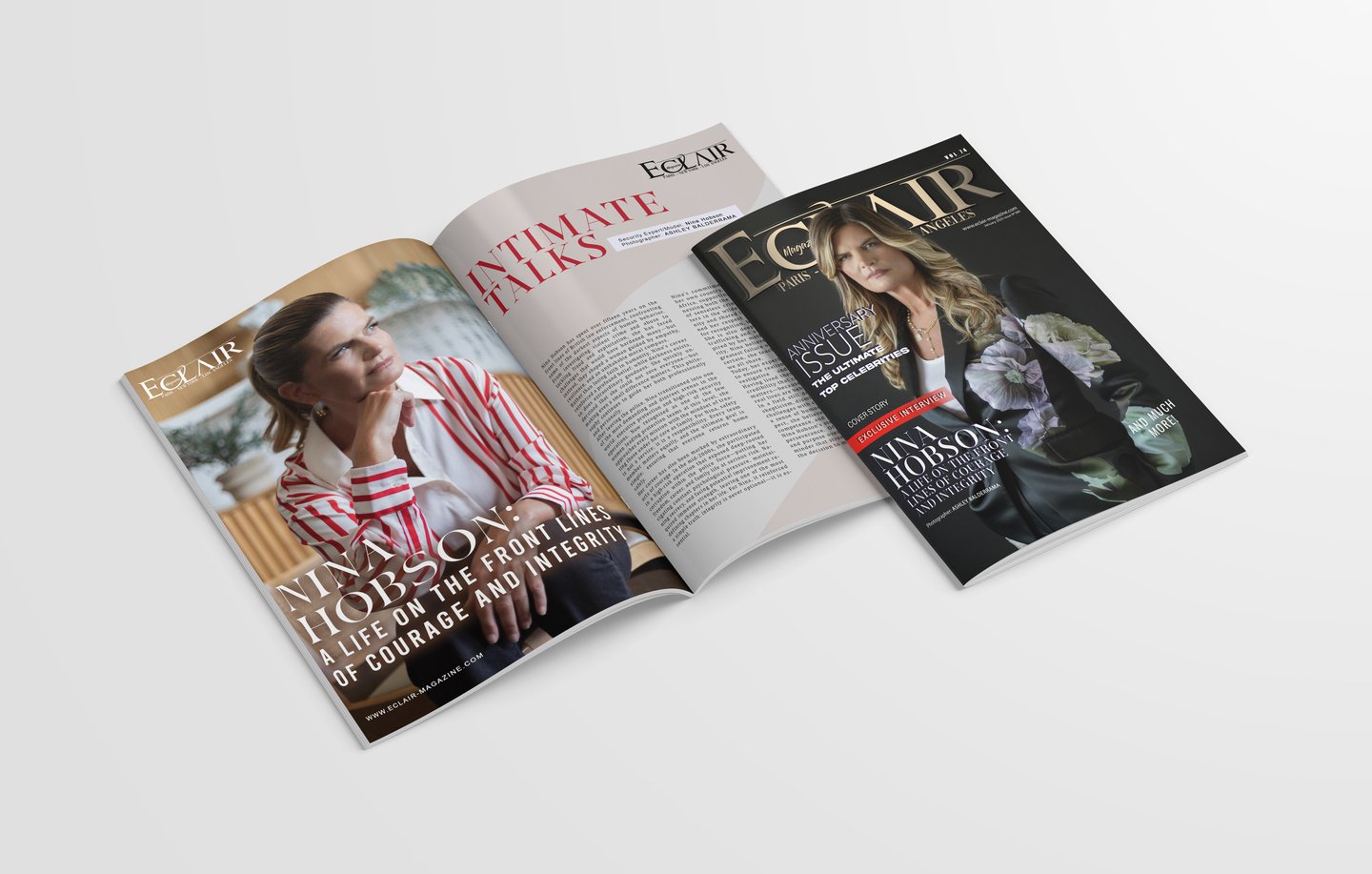
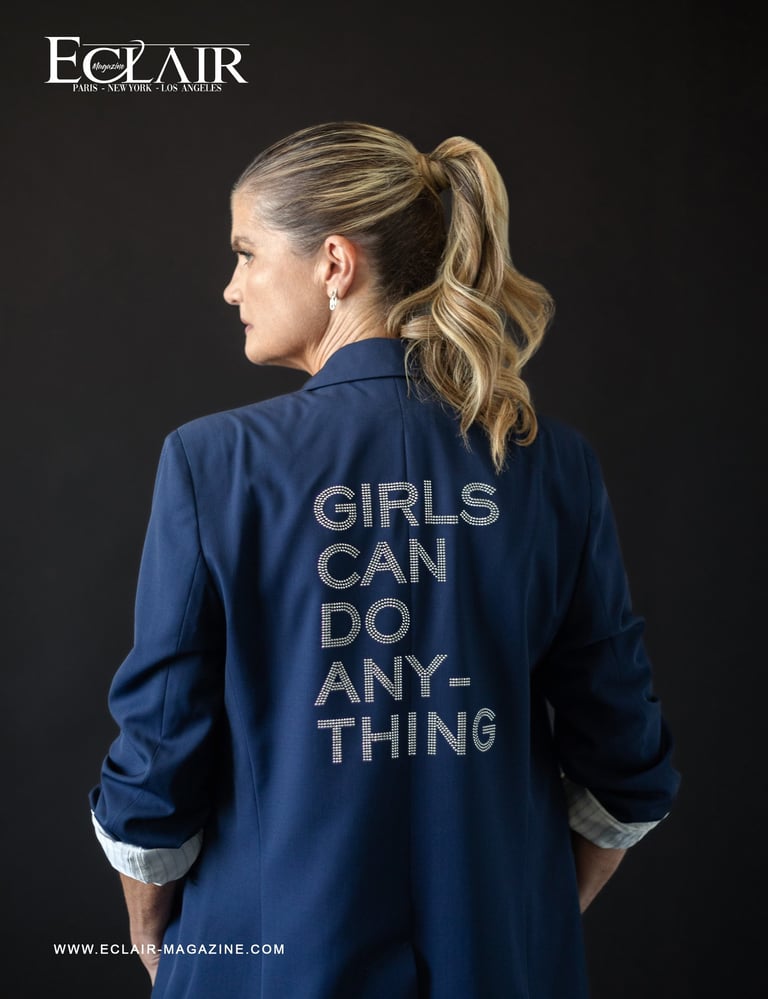
Security Expert/Model: Nina Hobson
Photographer: Ashley Balderrama
7. You are also involved in preventing sex trafficking and conducting rescue operations for victims. What drives your commitment to these causes?
I was brought up by the most amazing mum. And as the saying goes, only the good die young. She was one of the good ones and died way too young, but before she lost her fight to cancer, she taught me to fight for what is right. As a young white woman in Africa in the early ’70s, she visited her young gardener in a prison of young Black men because she knew he was not guilty of the crime he’d been sentenced for. She visited him every day to make sure he was fed and fought tirelessly for his freedom. It took a while and many people told her she was crazy, some even distancing themselves, and she took on political leaders making little headway. But she continued—relentless and determined. She did it quietly, without seeking recognition or accolades. So I guess my mum is what drives me. She taught me right from wrong, good from bad, and to never, ever give up—a lesson I’ve had to use in both my professional and personal life many times. If I don’t try to make a difference, and neither do you, then who does? And if I fail, I fail knowing I gave it a go.
8. Your expertise is sought by major platforms. How does your field experience influence your role as a consultant for these productions?
I don’t think there is any substitute for “on-the-ground” training. Authenticity is everything. I can’t tell you how to fix a car because I don’t know—but I can pretend I do. I can tell you how to investigate a murder, and I can tell you how to do it well because sadly, I’ve done it. I’ve worked in that field in every situation and made mistakes along the way, most of the time learning from them—and this has to come across to the production and the viewer. People are fascinated by true crime, hopefully because they are never going to be that close to it themselves, so it’s important that the person or the show they’re watching is real. As a consultant on a TV show, you need to know your subject matter. As a consultant, you are a teacher, and I take that role very seriously. The audience needs to know that you have felt that pain, been in that situation, succeeded and failed.
9.As a woman in a male-dominated industry, what obstacles have you faced and how have you overcome them?
I hate this question because yes, I have faced many situations as a female in a man’s world, but I have also faced obstacles that had nothing to do with gender. One of the hardest things in the industry is gaining respect. Thirty years in, and I still feel like I have to work hard at this. Not everyone—but some—don’t respect me because I’m female and they don’t feel I’m good at my job. There are times when I know a male operative is better suited for a job than I am, and that’s okay—I don’t have an issue with that.
I was recently called “sweetheart” by a team member, and I told him, “You only get to call me sweetheart if you’re buying my Tiffany jewelry. Call me that again and you’re fired.” Would he have said something similar to a man? Hell no.
I have walked into rooms where I’ve been ignored while the boys’ club pats themselves on the back. I’ve been given “female” duties, passed over for promotions, and heard every sexual innuendo and sarcastic comment imaginable. Am I going to go on about it not being fair or equal? No, because neither is life, and it takes too much out of you. There are other ways to deal with it, and many moments of pure satisfaction.
Recently, after being ignored by several protection officers the entire night, we ended up in the same space and they all introduced themselves to each other. I interrupted and said, “My name is Nina Hobson, and yes, my detail is ____. Crazy, isn’t it, that an old middle-aged woman could possibly look after anyone? Lovely to meet you.” Their uncomfortable silence was highly entertaining. I used to be offended; now it’s amusing because I realize it’s not about me—it’s about their inadequacies.
And yet, when you have a good group of guys—there’s no better place to be. Is it right that we have to work harder? No. Will it change? I believe not. But it makes us females a force to be reckoned with.
10. For those aspiring to follow in your footsteps in executive protection or complex investigations, what key advice would you give?
I honestly wake up every day—sometimes after only a few hours of sleep—thinking, “Wow, I get to work with amazing people today, and what will I learn?” I am so fortunate that I was able to join a company, Torchstone Global, who, despite the AMAZING skills and pedigree of their personnel, viewed me as an equal. They listened to my years of knowledge and experience and embraced it, as I do theirs. My boss blows me away—he inspires me without even knowing. I always want to hear his stories.
We have an amazing cross-section of people—young, old, short, tall, you name it—and I’ll tell you why: because everyone has a purpose and a strength. We care about what we do, how we do it, as a company and for all our clients. That sets us apart. It reflects in the service we provide, the way we treat colleagues, and the way we succeed as individuals and as a team.
So, to answer your question: find these types of people. There are always people willing to help you and who you can learn from. These people might not be the first ones you meet—sometimes it’s the bad encounter that almost makes you give up—but if you find the right people and the right support, you will succeed.
I know you expect me to say “don’t give up,” but I’ll say this instead: you can give up—but don’t you dare give up without trying.
Quality, not quantity
We have made quality our habit. It’s not something that we just strive for – we live by this principle every day.